Why "Gripping" Beats "Suction" for Cheese Stick Sorting — A Food-Line Field Note
The smallest task on a production line is often the hardest to automate.Take cheese stick sorting. The sticks are soft, coated in a thin layer of oil and moisture, and tumble every which way along the conveyor. This one "little" item has stumped plenty of automation engineers: rigid grippers slip, suction cups leak, and the moment you finally hold on, a dent appears.Here's how we solved it on a snack-food line — with a combination of soft gripper and soft wing end effectors.
Why Cheese Sticks Are Hard to Grip
Plain and simple: cheese sticks combine every "hard-to-grip" trait — soft, slippery, oily, and irregularly shaped.
- Oily, wet surface, low friction — rigid grippers slide off; vacuum cups can't seal, so drops and rework become routine;
- Soft and easily deformed — even when gripped, point-contact pressure from rigid jaws flattens, dents, or even snaps the stick, hurting yield;
- Mixed sizes, frequent changeovers — rigid tooling has poor compatibility; each new size needs a new fixture, which is slow and costly, and can't keep up with small-batch, high-mix orders.
In one sentence: you can't grab it, you can't grip it well, and you can't afford to. That's why most food lines still rely on manual sorting
Why Conventional Solutions Fail
The industry has tried automation — but every conventional path hits a wall:
| Approach | Problem |
| Rigid grippers | Point-contact stress causes dents and breakage, hurting yield |
| Vacuum cups | Poor sealing on oily surfaces and curved rod shapes; frequent drops |
| Full robot-arm cells | High investment, long deployment; too heavy for lines mid-transition |
The Fix: Soft Gripper + Soft Wing — One Wraps, One Sucks
Our answer is a combination of two flexible end effectors, switched by process step:
- Soft gripper · conformal wrapping grip: the soft body adapts to the stick's irregular surface for a gentle touch and firm hold — stable for side pick-up and posture correction, with zero dents throughout;
- Soft wing · conformal suction grip: flexible wing blades follow smooth surfaces while vacuum provides a steady hold — a faster pick cycle for clean, flat-up workpieces.
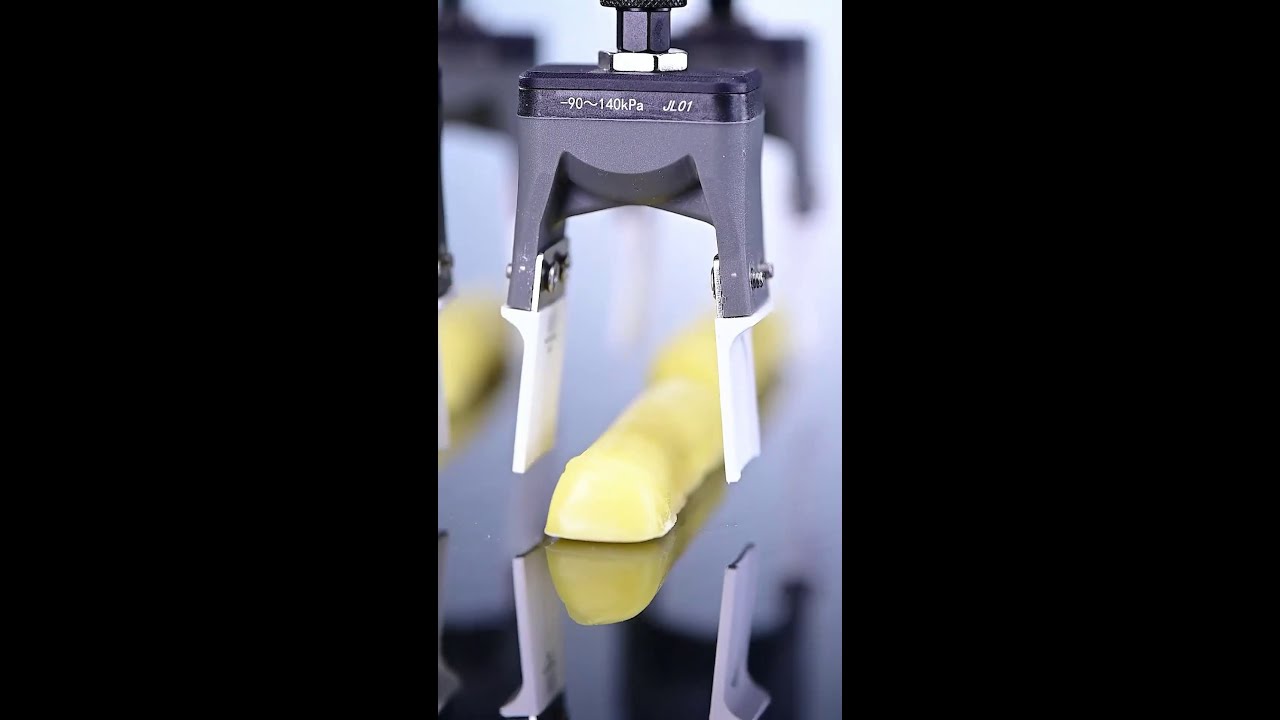
Both end effectors share one pneumatic drive unit — plug-and-play, no programming required, and operators can be trained in minutes. Food-grade contact materials keep hygiene and safety fully in check.
The hardest part of food automation isn't technology. It's having the courage to try first.A single cheese stick isn't worth much — but the line efficiency, yield, and flexibility behind it decide a brand's competitiveness. What the soft gripper + soft wing combination delivers is validation cost compressed from the system level to the tool level: take a handheld unit to the site, and in one minute you'll know whether your workpiece can be gripped — before committing to larger-scale automation.In automation, the most expensive thing is never the equipment. It's uncertainty. Our job is simply to turn "uncertain" into "certain."Want to verify grip feasibility on your own workpieces? Bring a sample — we'll prove it on the spot.