Soft Gripper for RAM and Memory Module Handling: Gentle, Stable and ESD-Safe Automation
Soft Gripper for RAM Memory Module Handling
Automating the handling of RAM and memory modules can be tricky when the products are closely packed in a tray and the contact area available for gripping is limited.In this application, the memory modules were placed vertically in a dense tray. The automation system needed to pick several pieces at the same time, while avoiding damage to the electronic components and considering ESD protection.The main issue was not simply how to pick up the memory modules, but how to do it within the limited space available.
The Gripping Challenges
Limited contact area on the memory module
RAM modules contain memory chips and other electronic components on their surface.With a conventional rigid gripper, direct contact with these areas is generally avoided. The gripper therefore needs to hold the module from its side.The problem is that the side area available for gripping is relatively small. This limits the contact area and can make the module less stable during transfer.For a high-value electronic product, the gripping method also needs to avoid unnecessary pressure or hard contact with the component surface.
Limited space between products
The memory modules were arranged vertically and relatively close together in the tray.This left only a narrow gap for the gripper to enter.At the same time, picking one module at a time would reduce handling efficiency. Several modules needed to be picked in the same cycle, which meant that multiple gripping units had to fit into the available space.Changing the tray to create more room was not the preferred option, so the gripping mechanism needed to work within the existing tray layout.
ESD requirements
Because the product is an electronic component, the gripping material also needs to take electrostatic discharge into consideration.The contact material therefore needed to meet the ESD requirements of the application rather than simply focusing on mechanical gripping performance.
The Soft Gripper Solution
The solution used soft gripping elements that could make direct, compliant contact with the memory modules.Instead of relying on a small rigid contact point at the side of the module, the soft material conforms to the product during gripping.This provides a more distributed contact area and avoids the need for a hard gripping surface.For the application, this helped address the issue of limited side contact while keeping the memory modules stable during transfer.
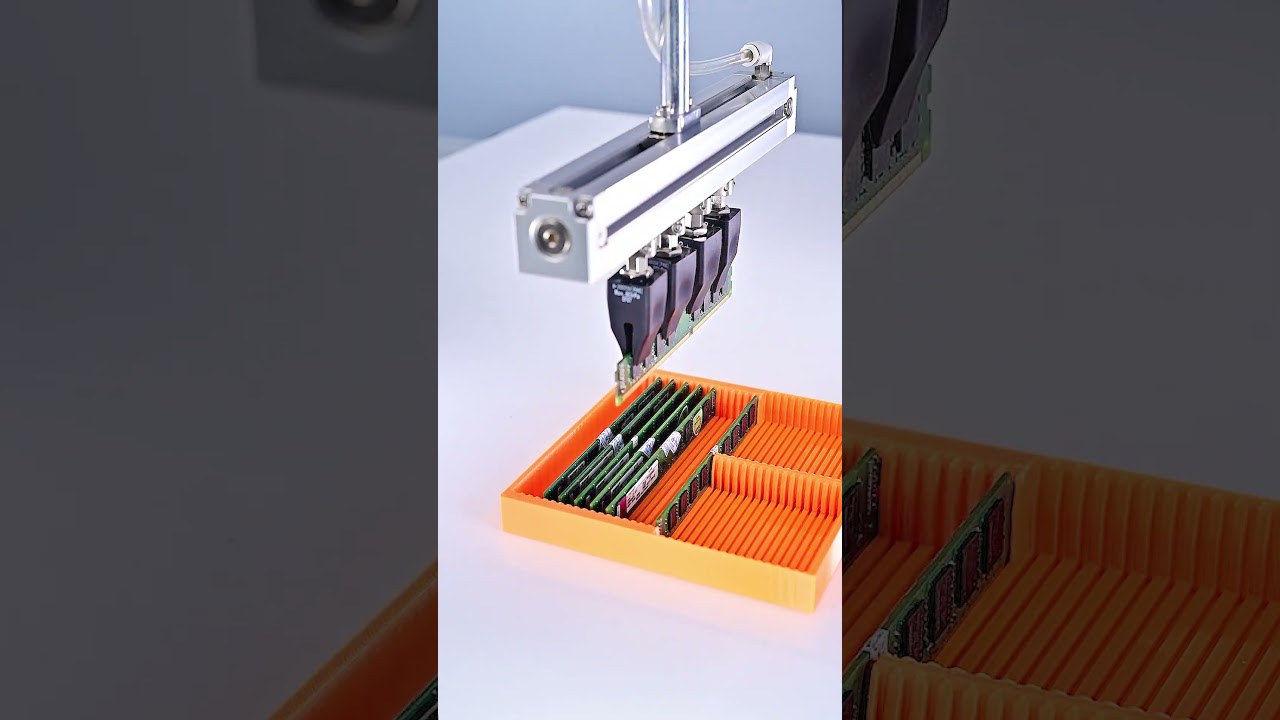
Working within the existing tray
The compact size of the gripping elements made it possible to arrange several units according to the spacing of the memory modules.The units could be placed side by side or in a matrix layout to match the tray arrangement.This allowed multiple modules to be handled in one cycle without requiring the tray to be modified simply to make room for the gripper.For the production line, the benefit is straightforward: the existing tray layout can be retained while maintaining multi-piece handling.
ESD-safe material options
For this type of electronics application, the gripping material can be selected according to the required ESD characteristics.This means the same gripping concept can be adapted for applications where contact with sensitive electronic components requires additional electrostatic protection.
What This Solves for the Application
For this RAM handling application, the main improvements are practical rather than complicated:
- The memory modules can be contacted more gently instead of relying on hard rigid fingers.
- The gripping area is less dependent on the narrow side edge of the module.
- Multiple gripping units can fit into the existing tray spacing.
- Several memory modules can be picked in the same cycle.
- The tray does not need to be redesigned just to accommodate the gripper.
- ESD-safe material can be used when required by the electronic product.
For similar electronics handling applications, the key is often to work around the actual product spacing and contact limitations rather than simply increasing the size or gripping force of the mechanism.In this case, a smaller, softer contact method provided a way to work within those existing constraints.