Why Soft Grippers with 3D-Printed Modules Make Automation Smarter
In industrial automation, engineers are constantly balancing three challenges: flexibility, cost, and development speed. Traditional rigid grippers can work well for standardized products, but once production starts changing frequently, those systems often become expensive to maintain and difficult to modify.That’s why more manufacturers are turning to a combination of soft grippers and 3D-printed contour modules.This approach is not about making automation more complicated. It is about creating a gripping system that can adapt quickly to real production needs without requiring a complete redesign every time a product changes.
Why Traditional Rigid Tooling Struggles
Conventional automation solutions are usually designed around a single product shape. Engineers create dedicated fixtures, machine custom parts, and spend significant time tuning the system for one specific application.The problem is that modern production rarely stays the same for long.Factories today often deal with:
- Multiple product sizes
- Short production cycles
- Customized orders
- Frequent design updates
- Small-batch manufacturing
Under these conditions, rigid tooling becomes costly and inefficient. Even small product adjustments may require new machining, long lead times, and repeated testing.
What Makes Soft Grippers Different
A soft gripper is designed to adapt naturally to different shapes and surfaces. Instead of relying entirely on rigid positioning, it uses flexible materials to create stable contact with the workpiece.This makes soft gripping especially useful for handling:
- Fragile products
- Irregular components
- Sensitive surfaces
- Food items
- Electronics
- Medical parts
Because the gripping force is distributed more evenly, the risk of damaging the product is significantly reduced.Rather than forcing the object into a fixed position, the gripper conforms to the object itself.
The Purpose of the 3D-Printed Module
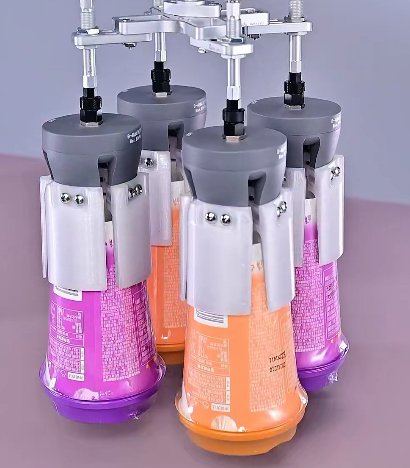
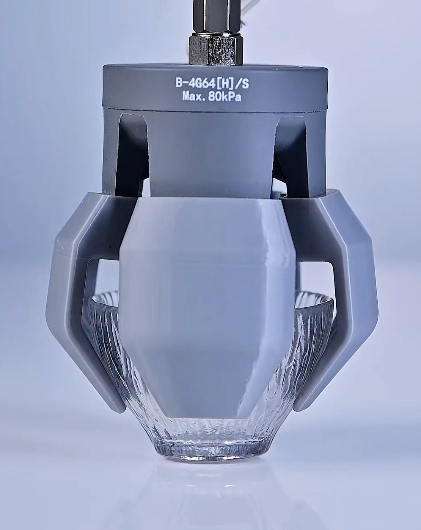
The 3D-printed contour block adds another level of control to the system.Instead of replacing the soft gripper, the printed module helps guide and position the product more consistently during gripping and handling.This creates a balance between:
- Flexibility from the soft gripper
- Precision from the contour structure
The result is a gripping solution that is both adaptable and repeatable.For many non-standard automation projects, this combination performs better than fully rigid tooling alone.
Faster Development with Lower Costs
One of the biggest advantages of using 3D-printed modules is development speed.Traditional tooling modifications often involve:
- CNC machining
- Outsourced manufacturing
- Mold production
- Long waiting periods
- High engineering costs
With industrial 3D printing, engineers can redesign a contour structure digitally and produce a new version within hours instead of weeks.This allows faster testing and much lower trial-and-error costs during automation development.Instead of rebuilding the entire end effector, only the modular section needs to change.
Modern Industrial 3D Printing Is Highly Durable
Many people still think 3D printing means weak plastic parts. That assumption is outdated.Today’s industrial-grade printing materials are engineered for demanding industrial environments. Advanced resins and reinforced materials can provide:
- High wear resistance
- Strong impact performance
- Excellent dimensional stability
- Lightweight structures
- Long service life
In soft gripping applications, the flexible gripper itself absorbs much of the contact force, which further reduces stress on the printed module.This improves overall durability while maintaining gentle product handling.
Easier Maintenance and Replacement
Another major benefit of modular gripping systems is simplified maintenance.If a contour module becomes worn or damaged, engineers do not need to replace the entire gripper assembly. Since the design file already exists, a new module can simply be printed and installed quickly.This helps reduce:
- Production downtime
- Spare part inventory
- Maintenance expenses
- Supply chain delays
For manufacturers focused on efficiency and rapid production changes, this flexibility can be extremely valuable.
Ideal for Non-Standard Automation
As manufacturing becomes more customized, automation systems need to handle greater product variation without increasing engineering complexity.Soft grippers combined with 3D-printed contour modules are especially effective for:
- Electronics assembly
- Packaging automation
- Food processing
- Medical manufacturing
- Consumer products
- Automotive components
The modular structure allows engineers to adapt the gripping solution quickly while keeping the main system unchanged.
A More Practical Approach to Automation
The goal of modern automation is no longer to build one rigid system that only works for a single product.Manufacturers now need automation platforms that can evolve with production demands.A soft gripper paired with a 3D-printed module offers a practical way to improve flexibility, reduce development costs, and accelerate deployment without sacrificing performance.Instead of pursuing expensive “one-time perfect tooling,” engineers can build adaptable systems that are easier to optimize and maintain over time.