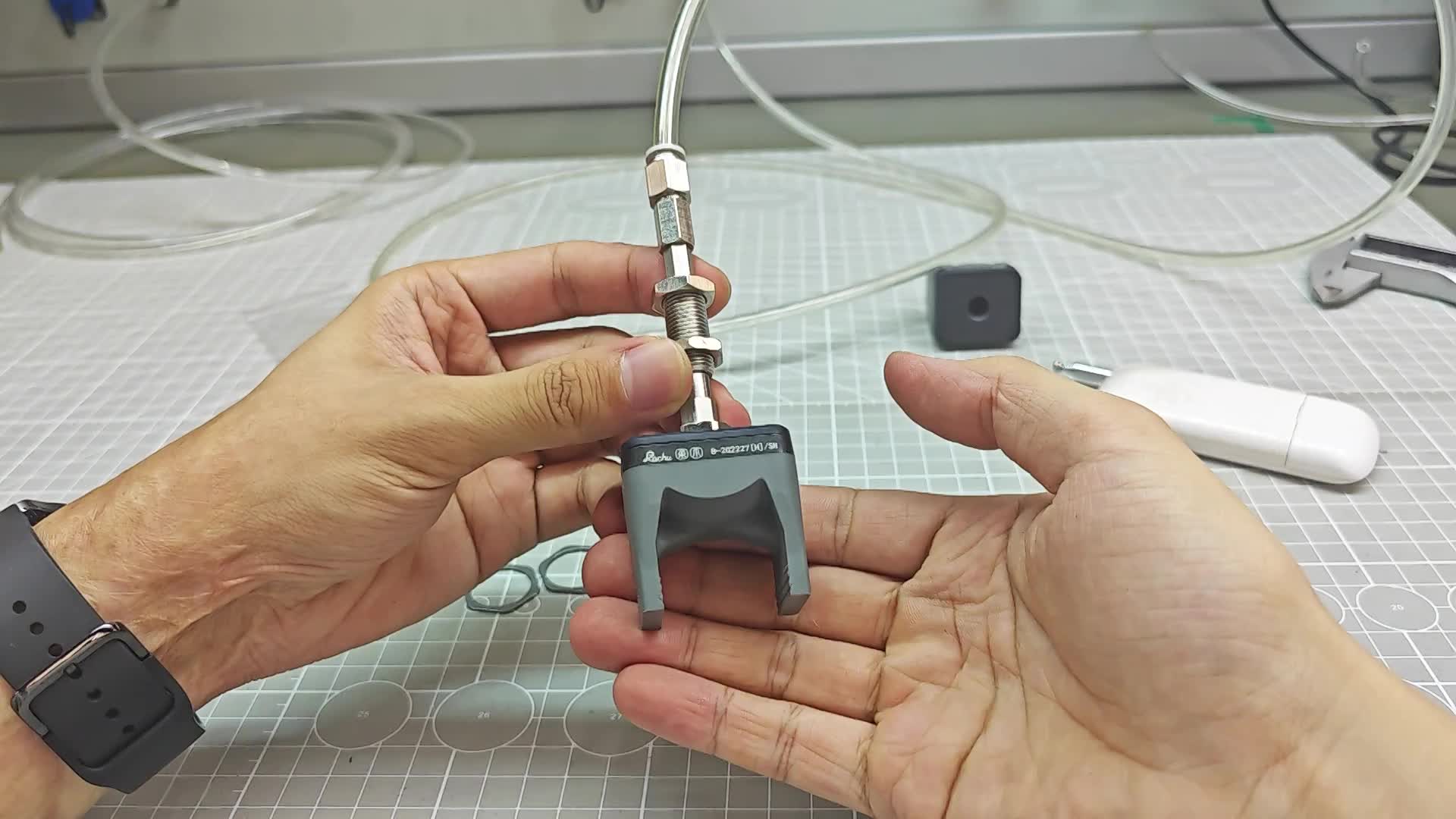
One Gripper for Five Metal Washer Sizes: Simplifying Automated Washer Handling
Why Metal Washer Handling Is More Challenging Than It Looks
Metal washers may appear to be simple components, but automating their handling can be surprisingly difficult.In many manufacturing processes, washers are supplied in trays and need to be picked individually before being accurately placed into fixtures for assembly, inspection, or subsequent machining. The challenge becomes greater when a single production line processes multiple washer sizes.Traditionally, manufacturers often prepare different grippers for each washer specification. Every product change requires mechanical adjustments or even replacing the end effector entirely, resulting in longer downtime, higher tooling costs, and increased maintenance.As production shifts toward high-mix, low-volume manufacturing, a more flexible gripping solution becomes increasingly valuable.
In this project, the robot performs the following tasks:
- Pick individual metal washers from a tray
- Transfer each washer to a dedicated fixture
- Ensure stable positioning without scratching the surface
- Handle five different washer sizes using a single gripper
The biggest requirement was flexibility.Instead of changing tooling whenever the washer diameter changed, the customer wanted one gripper capable of adapting to all five specifications while maintaining positioning accuracy and production efficiency.
Why Traditional Grippers Struggle
Conventional mechanical grippers are typically designed around one specific part geometry.When handling multiple washer diameters, manufacturers often encounter several issues:
- Separate grippers required for different washer sizes
- Frequent production changeovers
- Increased inventory of spare tooling
- Longer machine downtime
- Higher maintenance and operating costs
Although each washer differs only slightly in diameter, even small dimensional changes can require completely different jaw designs.
A Flexible Gripper That Covers Five Specifications
A flexible robotic gripper offers a more practical approach.Instead of relying on rigid jaw geometry, compliant gripping fingers automatically adapt to different washer diameters while maintaining stable gripping force.For this application, a single gripper successfully handles five washer specifications without mechanical replacement or manual adjustment.Key advantages include:
- One gripper for five washer sizes
- Stable single-piece picking from trays
- Reliable placement into fixtures
- Fast product changeovers
- Reduced tooling investment
- Simplified maintenance
For manufacturers running multiple product variants, this flexibility can significantly improve overall equipment utilization.