Why Food Handling Is Challenging for Robots: Soft Robotic Gripper Solution for Delicate Foods
Why Food Handling Is Difficult for Robots
In modern food manufacturing, automation has become increasingly common. Robots can perform repetitive tasks with high speed and accuracy, improving production efficiency and consistency.However, when it comes to handling delicate food products, automation is still facing significant challenges.A piece of cheesecake may look simple to pick and place, but for robots, it is a complex task.Unlike industrial parts made of metal or plastic, food products often have:
- Soft and fragile textures
- Irregular shapes
- Sensitive surfaces
- Strict hygiene requirements
These characteristics make traditional robotic gripping methods difficult to apply.
Why Traditional Grippers Struggle with Delicate Food Products
Traditional robotic grippers are mainly designed for rigid and predictable objects.They perform well when handling products with fixed shapes and strong structures. However, food products require a different approach.
1. Excessive gripping force can damage food
Rigid mechanical grippers usually rely on fixed contact points and controlled force.For soft foods such as cheesecake, pastries, and bakery products, even a small amount of excessive pressure may cause:
- Surface marks
- Shape deformation
- Product damage
The challenge is not simply picking up the product, but picking it up gently and reliably.
2. Vacuum suction has limitations in food applications
Vacuum cups are widely used in automation because of their simple structure and fast response.However, in food handling applications, they may face several issues:
- Crumbs and powder can enter the air system
- Uneven surfaces may reduce suction stability
- Soft products may deform under vacuum force
For products like cakes, bread, and pastries, maintaining cleanliness and stable gripping can be difficult.
A More Adaptive Approach: Soft Robotic Grippers
To overcome these challenges, soft robotic grippers provide a new solution for delicate food handling.Unlike traditional rigid grippers, soft grippers use flexible materials and adaptive structures to better follow the shape of the product.During gripping, the flexible contact surface can:
- Adapt to different shapes
- Distribute gripping force more evenly
- Reduce pressure concentration
- Minimize product damage
This allows robots to handle food products in a way that is closer to human hand movements.
Cheesecake Handling with Soft Robotic Gripper
In cheesecake handling applications, the main challenge is maintaining product quality while achieving automated production.The soft robotic gripper gently surrounds the cheesecake piece and provides stable support without damaging its surface.Compared with traditional gripping methods, the adaptive structure helps achieve:
- Gentle handling of fragile products
- Reliable pick-and-place operations
- Reduced product deformation
- Improved automation consistency
This makes soft robotic grippers suitable for food processing, packaging, and sorting applications.
The Future of Food Automation: From Precision to Adaptability
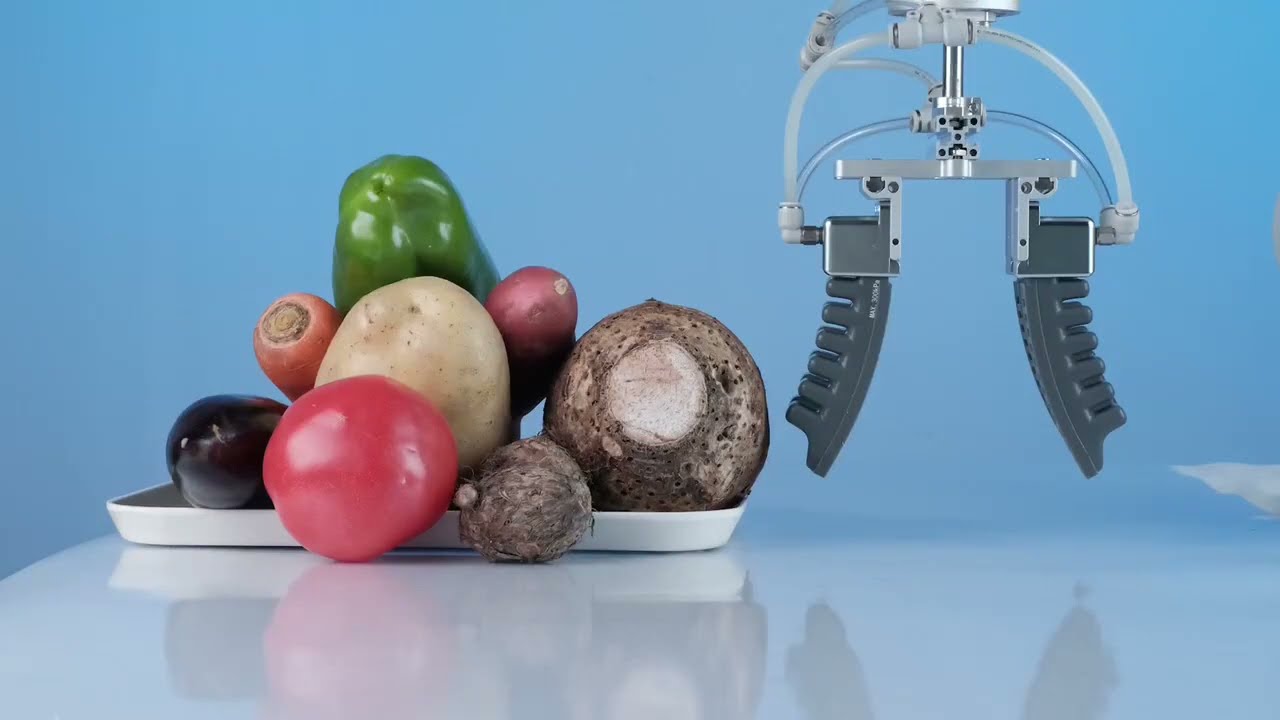
Traditional automation focuses on speed, accuracy, and repeatability.However, real-world products are not always perfect geometric objects.Food products are soft, variable, and sometimes unpredictable.The future of automation is not only about making robots faster or stronger.It is about making robots more adaptable.Soft robotic grippers represent a new direction in industrial automation — enabling robots to interact with delicate products in a more flexible and intelligent way.From cheesecake and pastries to fruits, vegetables, and other fragile foods, adaptive gripping technology is helping expand the possibilities of food automation.
Food automation is not just a challenge of robot movement.It is a challenge of interaction.By combining flexible materials, adaptive gripping technology, and robotic automation, soft robotic grippers allow machines to handle delicate products with greater care and reliability.The goal is not to make products adapt to machines.The goal is to make machines better understand products.