How Challenging Is Bearing Shell Handling? Thin Walls, Tight Spacing, Multiple Sizes
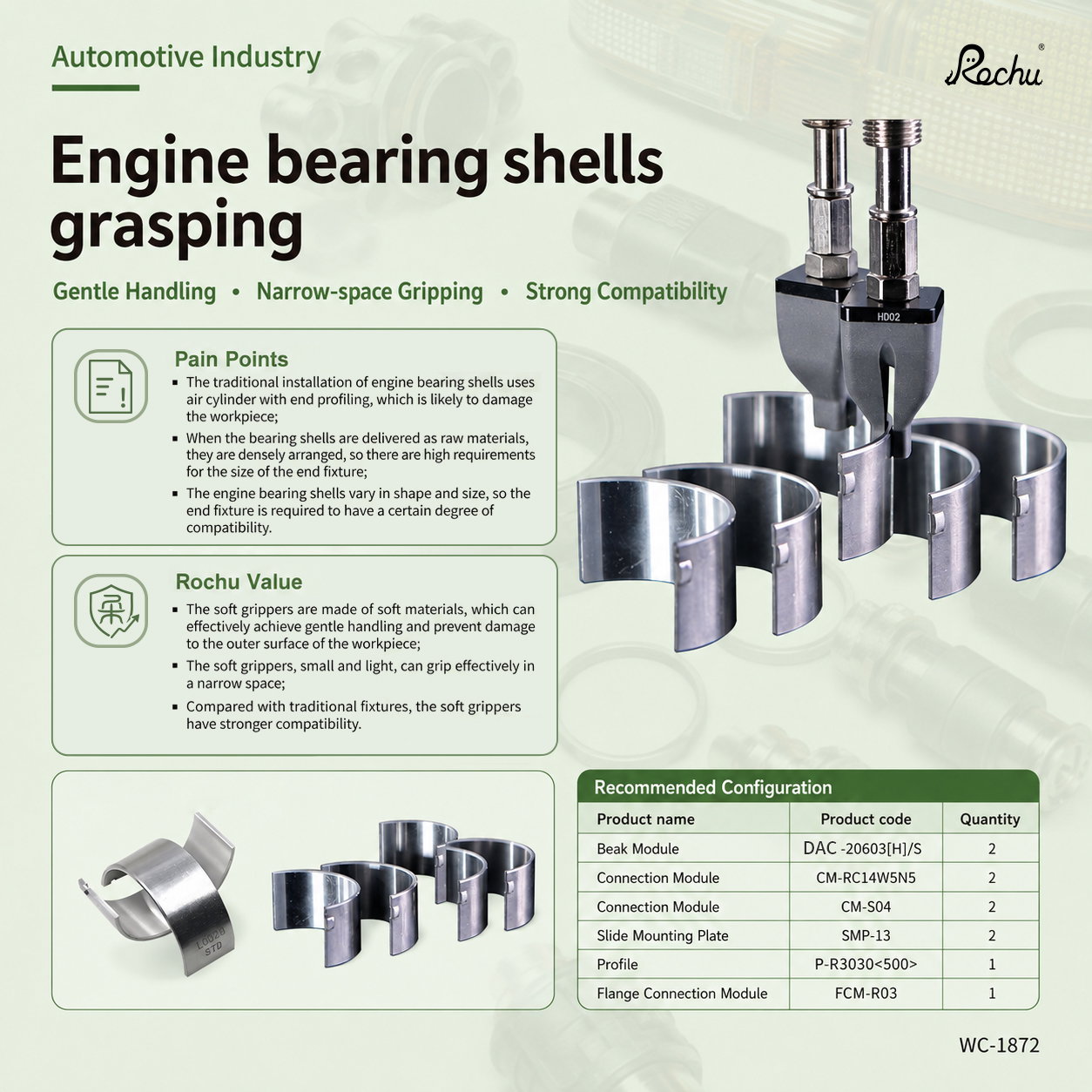
With precision components, simply being able to grip them isn't enough.Engine bearing shells are thin-walled, require high surface precision, and are often arranged closely together. For automated loading and unloading, the challenge is clear: avoid damaging the part, fit into tight spaces, and handle different sizes without excessive tooling changes.
Three Challenges in Bearing Shell Handling
Preventing surface damage, gripping parts in tight spaces, and accommodating different sizes are three key challenges that conventional gripping solutions must address.
What Can Soft Grippers Do Differently?
What if gripping didn't rely entirely on rigid, fixed-profile tooling?Soft grippers use material deformation to conform to a workpiece's shape, offering an alternative approach to contact, tool design, and size adaptability.
01 | Gentle Conforming Contact to Reduce Damage RiskSoft grippers deform to follow the workpiece contour, helping distribute contact pressure. For thin-walled bearing shells with demanding surface requirements, this can help reduce the risk of dents and scratches while maintaining a secure grip.
02 | Compact Design for Tightly Arranged PartsWhen the gaps between workpieces are limited, gripper size can determine whether a part is accessible. Soft grippers can be configured with suitable structures and modules to fit the available space, helping reduce interference during loading and unloading.
03 | Flexible Adaptation to Reduce Changeover WorkFor bearing shells of different sizes, soft grippers can accommodate dimensional variations within a suitable range through their deformation, reducing reliance on dedicated fixed-profile tooling.The actual compatibility range still needs to be verified based on workpiece dimensions, surface conditions, and gripping orientation. However, in multi-size production, this approach may reduce the need to change grippers between tasks.
From Handling One Part to Adapting to a Production Line
Bearing shell handling may look like a simple pick-and-place task, but it involves balancing contact mechanics, available space, and changeover requirements.Soft grippers aren't simply a replacement for conventional tooling. They offer another option when rigid contact, limited clearance, or changing workpiece specifications make gripping more challenging.In automotive manufacturing, automation needs to do more than repeat the same motion reliably. It also needs to accommodate variations in parts and production requirements.Protect the workpiece. Fit into tight spaces. Simplify changeovers.That's where flexible gripping can make a difference on the factory floor.