Can Traditional Grippers Keep Up? Soft Robotics Is Transforming Precision Smartphone Component Handling
The Hidden Automation Challenge in Smartphone Manufacturing
As smartphone manufacturing moves toward zero-defect production, even micron-level challenges can become critical bottlenecks affecting yield and efficiency.One typical example is the automated handling and assembly of smartphone volume buttons. These ultra-thin components are usually only about 1.2 mm wide and often less than 1 mm thick. Moving such delicate parts accurately and without damage to the correct position places extreme demands on the end-of-arm tooling (EOAT).
The Conflict Between Size and Precision
Traditional pneumatic grippers typically use metal fingers wider than 2.5 mm, while the thickness of a volume button is often under 1 mm.It’s like trying to pick up a sheet of paper with chopsticks—the contact area is too large to apply force precisely at the ideal gripping point. As a result, parts can easily shift, tilt, or collide during handling.
The Conflict Between Force and Fragility
The surface finish of smartphone buttons has zero tolerance for scratches.However, traditional pneumatic grippers usually deliver force in a simple on/off manner, making it difficult to control force at the millinewton level. Excessive gripping force may lead to permanent marks or micro-deformation.At the same time, repeated contact between metal fingers and plastic or metal components can generate static electricity, increasing the risk of damaging sensitive micro-electronics.
The Conflict Between Fast Iteration and Rigid Tooling
The 3C electronics industry evolves extremely fast. Button sizes and shapes often change with each new product generation.Traditional solutions based on fixed fixtures lack flexibility and struggle to support the increasingly common manufacturing model of small batches and high product variation.
What the Industry Really Needs
In simple terms, the ideal gripping solution needs to be:
- Slim enough to access tiny components
- Gentle enough to avoid damage
- ESD-safe to protect sensitive electronics
- Flexible enough to adapt to product changes
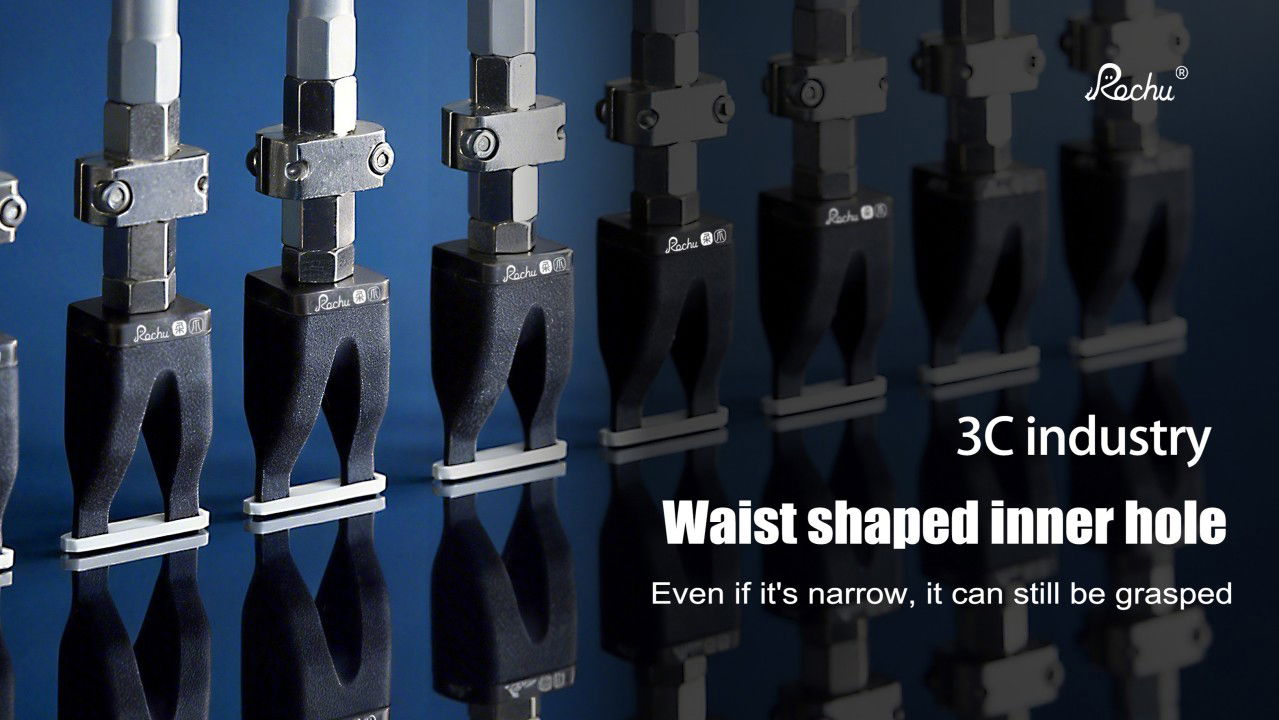
To address these challenges, soft robotic grippers designed for precision electronics handling are emerging as a practical solution—combining innovations in materials, structure, and control to enable reliable handling of ultra-small components.One of the key advantages of soft robotic grippers lies in their high level of customization.For example, when handling long and narrow components such as smartphone volume buttons with a width of only 1.2 mm, a micro soft gripper can be specially designed with fingertip dimensions precisely matching the 1.2 mm profile.This tailor-made approach allows the gripper to function much like a pair of precision tweezers, accessing the component through tiny reserved gaps or designated gripping surfaces on both sides of the button.By enabling internal expansion gripping, the soft gripper can gently secure the component while avoiding surface contact that could cause scratches or deformation.As a result, ultra-thin parts can be handled accurately and without damage, effectively solving the primary challenge of limited physical space and interference during automated handling.
The case shown above is only one of many possible applications.If you have similar handling challenges or would like to explore more automation scenarios, feel free to connect or leave a comment