Why Do Engineers Care More About End Effectors Than Robots?
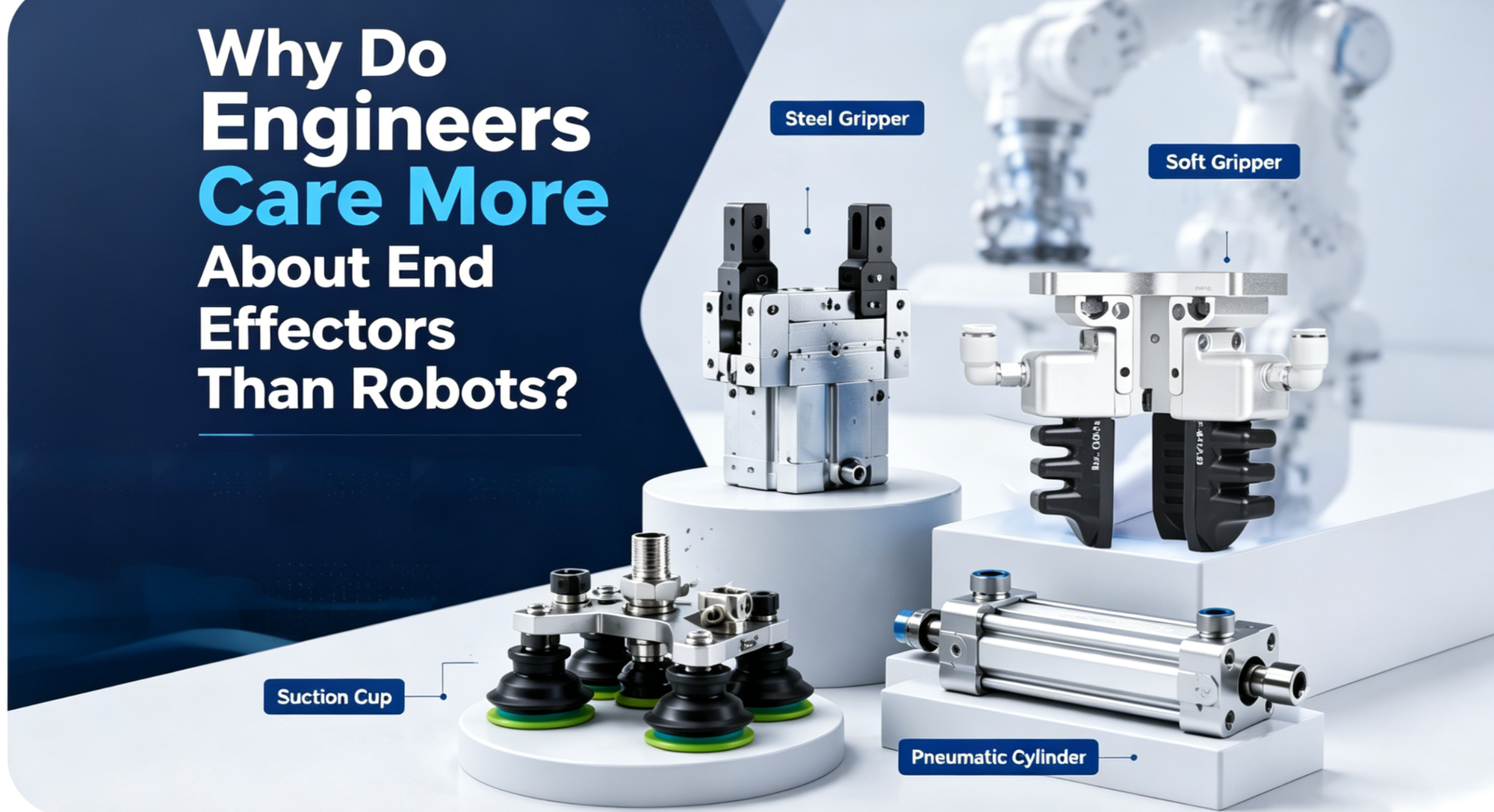
When people first enter the world of automation, their attention is almost always drawn to the robot itself:Is it a 6-axis robot or a SCARA? What’s the payload? How accurate is it? Which brand is it?But once automation is actually deployed on production lines, a very different reality starts to emerge:Engineers gradually care less about the robot body—and much more about the end effector.In fact, when it comes to production stability, the upper limit is often not defined by how powerful the robot is, but by how capable its “hand” is.
A useful way to frame automation is simple: Robot → movement Control system → logic End effector → physical interaction And in real production, failure rarely happens in motion.It happens at the moment of contact.
- Dropped parts.
- Deformed products.
- Surface damage.
- Unstable suction.
- Frequent retooling.
None of these are robot problems. They are end-effector problems.
In industrial automation, an “end effector” is not a single fixed device, but rather a functional category.
It refers to all tools or mechanisms that directly make physical contact with the workpiece, serving as the final stage of a robotic system responsible for actions such as gripping, handling, aligning, and releasing.Common types include:Mechanical grippers (parallel grippers, angular grippers, adaptive grippers) Vacuum systems (suction cups, multi-cup array structures) Soft grippers (compliant structures, soft-material contact interfaces) Pneumatic actuators and end-of-arm tooling Custom application-specific tools (e.g., placement, positioning, pressing end effectors)Although these forms look very different, their essence is the same:They all serve as the “final interface” between the robot and the real physical world.
End effector selection is rarely about “best performance”It is always about matching interaction conditions.
- When the object is rigid and well-defined → mechanical grippers
- When the surface is flat and sealed → vacuum systems
But when parts are fragile or slightly variable → this is where problems startTypical scenarios:
- food products
- rubber parts
- coated surfaces
- irregular soft components
When variability becomes the main challenge → flexible grippers become relevantFlexible Soft grippers do not improve precision in the traditional sense.Instead, they change how the system behaves under uncertainty at the contact level.Rather than eliminating variability, they tolerate and absorb it through mechanical compliance.This shift happens in these practical ways:
1. Decoupling success from exact geometry
Rigid grippers require:
- precise alignment
- consistent part geometry
- repeatable approach conditions
Flexible structures reduce this dependency.Small deviations in position or shape no longer directly translate into failure.
In rigid systems, contact happens in a short, high-force instant. That moment is often where failures occur.Flexible structures:
- distribute force over a larger area
- smooth the transition during contact
- reduce peak stress concentration
As a result, the contact process becomes less sensitive to small disturbances.
2. Stabilizing the contact phase
In rigid systems, contact happens in a short, high-force instant. That moment is often where failures occur.Flexible structures:
- distribute force over a larger area
- smooth the transition during contact
- reduce peak stress concentration
As a result, the contact process becomes less sensitive to small disturbances.
3. Reducing sensitivity to batch variation
In real production, no two batches are truly identical.Rigid systems often require re-tuning when variations appear.Flexible grippers, by contrast:
- adapt passively to small differences
- reduce dependency on recalibration
- maintain more stable pick performance across batches
Automation used to be about movement.Now it is about reliable interaction
Because in real production:
- Robots move the system
- End effectors decide success.
And yield matters more than motion.