Мягкие держатели для бутылок: почему стандартные держатели часто оказываются неэффективными
In the food & beverage, pharmaceutical, chemical, cosmetics and logistics industries, bottled workpieces are among the most common objects handled on automated lines. Flexible grippers — praised for their "soft contact, self-adaptive conformance" — have become the go-to solution for fragile and oddly shaped parts. Yet when it comes to cylindrical containers that demand deep, full-circumference gripping — PET beverage bottles, glass sauce jars, reagent vials — standard flexible grippers repeatedly come up short: weak holds, unstable grips, even deformed bottles. Where exactly does the problem lie, and how do you break through?
1Core Limitations of Standard Flexible Grippers
Conventional flexible grippers were originally designed for small, flat, lightweight workpieces. When the application switches to bottled containers, four critical weaknesses surface at once:
Limited Gripping Stroke & Reach
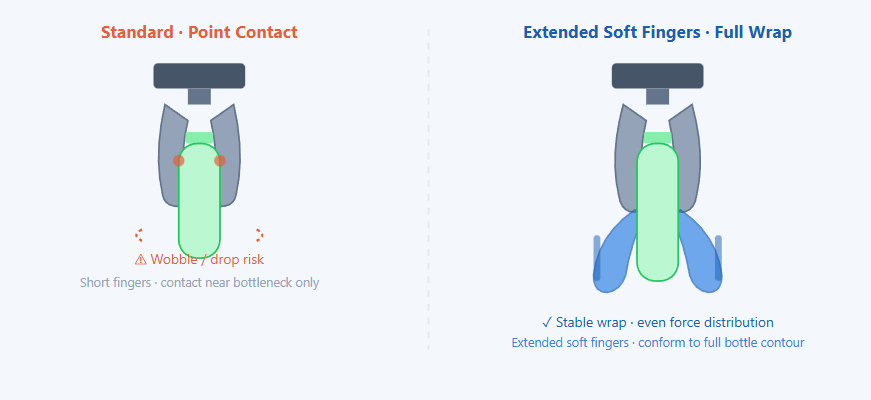
The gripper fingers are inherently short, resulting in insufficient gripping depth. They cannot cover the vertical dimensions of bottled workpieces and struggle to form an effective wrap — the fingers simply cannot reach the middle of the bottle body and only graze the neck or mouth area.
Unstable Grip Under Load
With a limited contact area, clamping force is distributed unevenly across the bottle surface, producing "point contact" instead of "surface contact." The result: workpiece wobble, misalignment and even drops during handling — especially critical in high-speed, continuous production.
Narrow Application Range
Standard grippers only suit small, flat, lightweight parts. For cylindrical or irregular bottled containers — PET bottles, glass bottles, reagent bottles — that require deep wrapping, adaptability is extremely poor, making them unsuitable for the continuous demands of batch production.
Workpiece Damage Risk
To force a grip on bottled workpieces, operators may increase clamping force — but because standard fingers are short, force concentrates on localized areas of the bottle, causing deformation, scratches or breakage (especially with thin-walled or fragile bottles). This creates an irreconcilable conflict between grip strength and workpiece protection.
Standard Gripper vs. Extended Soft Fingers: Grip Performance Comparison
Left: standard gripper only achieves point contact near the bottleneck. Right: extended soft fingers achieve full-circumference wrapping of the bottle body.
2How Extended Soft Finger Design Breaks Through
To address these pain points, soft gripper (soft wing) design offers a systematic solution — extending fingers with same-material soft wings at the finger tips, achieving maximum performance gains with minimal design changes:
Breaks the Reach Limitation
Same-material soft wings precisely compensate for finger length and gripping depth, letting the gripper fully conform to the vertical contour of bottled workpieces — a shift from "partial contact" to "full-circumference wrap."
Improves Grip Stability
The extended soft wings increase contact area with the bottle body, distributing clamping force evenly. This effectively suppresses wobble and misalignment, reduces the risk of drops, and ensures reliable continuous operation.
Preserves the Core Soft-Gripping Advantage
Made from the same compliant material as the original fingers, the soft wings retain the "soft contact, self-adaptive conformance" characteristic — no extension-induced damage to the bottle, balancing grip force with workpiece protection.
Expands Adaptability
Solves the bottle-gripping problems standard grippers cannot handle — medium-to-large bottles, deep-cavity bottles and irregular bottle shapes — while remaining compatible with different diameters and heights, boosting gripper versatility.
Reduces Production Loss
Stable wrap-style gripping minimizes production losses caused by dropped or damaged workpieces, improving efficiency and yield rates — every single grip, rock solid.
3Core Applications & Extended Use Cases
The extended soft finger design is no one-trick pony — it is a full-scenario solution built around bottle gripping. Below we explore it from two dimensions: core applications and extended use cases.
🎯 Core Application Industries
🥤Food & Beverage
Gripping, conveying and palletizing PET beverage bottles, glass sauce/condiment jars, and cans (extended soft wings match can height, preventing can-mouth damage).
⚗️Pharmaceutical & Chemical
Precision gripping and transfer of reagent bottles, sample vials, infusion bottles and chemical raw-material containers (with corrosion-resistant soft wing materials), meeting clean-room no-damage requirements.
🧴Cosmetics & Personal Care
Sorting and case-packing of plastic bottles for shampoo, body wash and laundry detergent, plus glass bottles for skincare and cosmetics on production lines.
📦Warehousing & Logistics
Inbound sorting, outbound packing and pallet stacking of bottled goods in various sizes, adapting to different bottle-height stacking requirements.
From "Holding It" to "Holding It Right, Holding It Safe"
Extended soft finger design systematically solves the four major bottle-gripping challenges — reach, stability, adaptability and protection — without changing the gripper's core structure. Whether standard or irregular bottles, every grip is precise, stable and damage-free.