Pneumatic, Soft or Electric Grippers — Which One Is the Future?
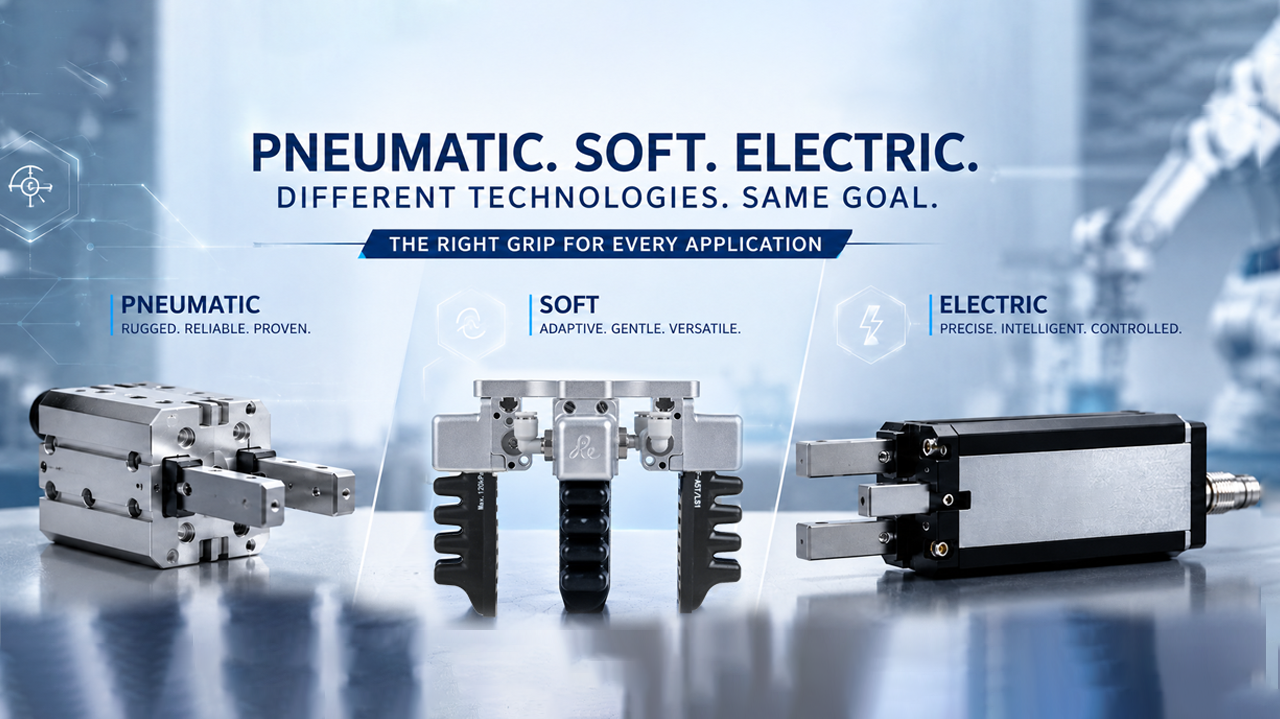
In industrial automation, pneumatic, soft, and electric grippers are often compared side by side.Some see electric grippers as the next step toward smarter automation.
Others believe soft grippers will play a bigger role as manufacturing becomes more flexible.
And despite being a mature technology, pneumatic grippers remain widely used because of their simplicity and reliability.But asking which one will eventually replace the others may be the wrong question.In real-world applications, these three technologies are designed to solve different problems.
Pneumatic Grippers: Mature, Direct, and Reliable
Pneumatic grippers are probably the “oldest brother” of the family.Their structures are relatively simple, their response is straightforward, and the technology has been proven across countless industrial applications.For regular workpieces such as metal parts, machined components, and repetitive handling tasks, pneumatic grippers can provide reliable and consistent performance over long production cycles.But they also have limitations.When the size, shape, or position of a workpiece changes, a conventional pneumatic gripper may need to be readjusted or even replaced.And for delicate components or applications requiring more precise force control, a rigid gripping approach is not always the best fit.That doesn't make pneumatic grippers outdated.It simply means they are particularly well suited to stable, clearly defined, and highly repetitive tasks.
Soft Grippers: Less About Force, More About Adaptability
Soft grippers take a different approach.Instead of simply pursuing higher gripping force, they use compliant structures that can deform and adapt to the shape of the workpiece.This can be particularly useful when handling objects that are irregular, thin-walled, soft, fragile, or difficult to grip with a conventional rigid fixture.The key advantage is simple:The workpiece doesn't always have to be perfectly standardized.But soft gripping also comes with its own trade-offs.Because the gripping process depends on material deformation and structural compliance, some applications that require extremely precise gripping positions or self-location may still favor rigid gripping mechanisms.In other words, soft grippers are designed to solve the problem of adapting to the object, rather than forcing every object to conform to the gripper.
Electric Grippers: More Control, More Complexity
Electric grippers bring another dimension to the equation: controllability.Gripping stroke, speed, and force can be adjusted more precisely, making electric grippers attractive for applications where workpiece dimensions vary or where the gripping process needs finer control.They can also be integrated more easily into increasingly digitalized automation systems.But greater controllability often comes with greater system complexity.Motors, sensors, controllers, and mechanical components all become part of the system. A problem in any one of these areas can affect the overall gripping process.So the advantage of electric grippers isn't that they simply “beat” pneumatic grippers.Rather, they trade greater system complexity for greater controllability and digital integration.
So, Which One Is the Future?
If we have to choose just one answer, we may already be looking at the question from the wrong perspective.Industrial automation rarely works on the principle that one technology can solve every problem.The more useful questions are:What is the workpiece?
How fast does it need to be handled?
How much gripping force is required?
How precise does the gripping process need to be?
Is the workpiece fragile?
How often does the production line change products?
What are the available power and control systems?These factors ultimately determine which type of gripper makes the most sense.Pneumatic grippers are well suited to stable, mature, highly repetitive applications.Soft grippers are particularly useful when adaptability, compliance, and gentle handling matter.Electric grippers are a strong option when precise control, parameter adjustment, and digital integration are priorities.So instead of asking “Which one will be the future?”, perhaps the better question is:What combination of end-of-arm technologies will future automation systems actually need?The future may not be about one type of gripper replacing another.It may be about putting each technology where its strengths make the most sense.Because in the end, industrial automation is not really about winning a technology debate.It comes down to a much more practical question:How do we pick this thing up — reliably, consistently, and cost-effectively?